What would you change about the world if you could? And how would you begin?
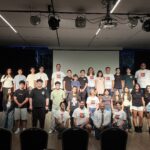
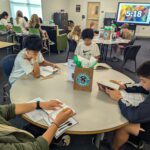
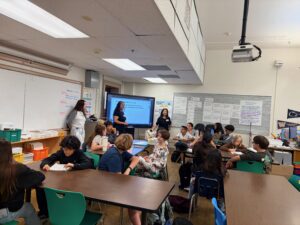 Those questions sparked a lively conversation in Mr. Silverio’s science classroom at Octavia E. Butler Magnet School when three professionals from Pasadena-based biotechnology company Xencor joined students to explore ideas for the upcoming PUSD Innovation Expo.
Students had plenty of ideas! Their interests quickly turned to the natural world and climate change, with questions about water filtration, disposable packaging, batteries, and car exhaust. How could they make these things better? And where should they start?
Nicole Rodriguez, Director of Bioanalytical Development; Nicole Karvelas, Senior Research Associate; and Julie Casciani, Executive Director of Human Resources, encouraged students to think creatively, ask questions, and explore possibilities.
One important lesson: Innovation doesn’t always mean inventing something new. Sometimes it means making something better. Think about the telephone. What began as a device connected to a wall by a cord has become something we carry in our pockets, combining a phone, camera, watch, and countless other tools.
The Xencor team offered practical advice for turning ideas into Innovation Expo projects. Make a list of pros and cons. Follow the scientific inquiry process. Draw pictures of what you’re imagining, even if you’re not an artist! A simple sketch can be the first step toward a proof of concept.
The PUSD Innovation Expo gives students opportunities to investigate questions, solve problems, and put their creativity to work through projects ranging from scientific inquiry and environmental innovation to invention and engineering. The visit helped students begin thinking about how to turn their own interests into projects worth exploring.
From Caltech to the Classroom
Founded through protein-engineering research developed at Caltech, Xencor is part of Pasadena’s community of innovators. Today, its scientists engineer antibodies, making precise changes to improve how they function and developing potential treatments for cancer and autoimmune diseases. It’s a real-world example of how asking “How can we make this better?” can lead to new possibilities.
The classroom visit was part of the Pasadena Educational Foundation’s SciTech Initiative, connecting PUSD students and teachers with the people, expertise, and resources of our community.
Thank you to Nicole Rodriguez, Nicole Karvelas, Julie Casciani, and Xencor for sharing their time, experience, and encouragement with Mr. Silverio’s students. As students prepare for the Innovation Expo, they have a great question to guide them: How can we make the world better?